

Why Is “Kitchen Cabinet Design”
One of the Most Important Elements of Interior Design?
“Cabinet design” is not merely a storage solution; it is one of the most significant interior architectural elements that defines the character of a living space.
Today, kitchens have evolved beyond being areas solely for food preparation. They have become central living spaces where family members gather, socialize, and spend a considerable part of their day.
For this reason, in a kitchen planned with an interior design approach, the visual appeal of the cabinets is just as important as their ergonomic functionality, harmony with the overall space, and ability to meet the users’ daily needs.
A successful kitchen design maximizes storage capacity while preserving freedom of movement by carefully analyzing the dimensions of the space. As a result, homeowners enjoy a kitchen that is both comfortable and durable for years to come.
The Planning Process of
Cabinet Design in Interior Design
The first step for a professional interior designer is conducting a detailed analysis of the kitchen’s physical characteristics.
Before beginning the “cabinet design” process, factors such as window placement, door openings, natural lighting, plumbing and electrical systems, and the number of users are carefully evaluated. Storage requirements are then determined, leading to the planning of base cabinets, wall cabinets, pantry units, and tall storage systems.
This process focuses not only on aesthetics but also on daily usage habits.
Frequently used items should be easily accessible, heavy kitchen appliances require durable support systems, and work areas should be organized to complement one another. These principles form the foundation of successful interior design planning.
“Kitchen Cabinet Design” from an
Ergonomic Perspective
In interior design, ergonomics aims to create the most efficient relationship between people and their living environment.
When developing a “cabinet design,” cabinet heights, shelf depths, drawer systems, and countertop levels should all be designed according to human ergonomics.
Wall cabinets installed too high can be difficult to access, while cabinets positioned too low may restrict movement.
Likewise, fully extendable drawer slides, internal organizers, and corner cabinet mechanisms significantly improve ease of use.
Interior designers strive to establish the perfect balance between aesthetics and functionality to maximize the overall user experience.
The Impact of Material Selection on
“Cabinet Design”
Material selection is one of the primary factors influencing both the durability and visual appeal of a kitchen.
During the “kitchen cabinet design” process, materials such as MDF, lacquer, acrylic, solid wood, melamine, and veneered surfaces are evaluated according to different usage requirements.
Scratch-resistant and moisture-resistant finishes are generally preferred for busy family kitchens, while natural wood textures and matte lacquer finishes are popular choices in luxury projects.
Beyond appearance, ease of maintenance, cleaning performance, and long-term durability are equally important considerations in interior design. Choosing the right materials helps maintain the kitchen’s original beauty for many years.
Color Selection and
Spatial Perception
In interior design, colors are not simply decorative elements—they are powerful tools that shape spatial perception.
Within a “kitchen cabinet design,” light colors make compact kitchens feel more spacious and brighter, while darker tones create a bold and sophisticated atmosphere.
White, off-white, beige, and light gray provide timeless elegance, whereas anthracite, black, and dark walnut finishes are frequently featured in contemporary interiors.
Interior designers evaluate flooring, wall colors, countertop materials, and natural lighting together to achieve a cohesive visual composition.
Modern Approaches to
“Cabinet Design”
Modern interior design emphasizes simplicity, clean lines, hidden details, and functionality.
For this reason, “kitchen cabinet design” often incorporates handleless cabinets, integrated handle profiles, slim-frame doors, and smooth cabinet surfaces.
Minimalist design reduces visual clutter while creating a more organized environment.
Integrated built-in appliances, concealed storage systems, and smart drawer organizers have become essential components of today’s modern kitchens.
Classic and Timeless
“Kitchen Cabinet Design”
Classic kitchens are appreciated for their warm and welcoming atmosphere.
Traditional interior design often highlights natural wood textures, framed cabinet doors, decorative hardware, and natural stone countertops.
In a classic “kitchen cabinet design,” symmetry is considered a fundamental design principle.
Balanced proportions and quality craftsmanship ensure kitchens remain stylish for decades. Classical details also add prestige and elegance, particularly in larger living spaces.
Increasing Functionality
Through Smart Storage Solutions
A successful “kitchen cabinet design” should offer more than visual appeal—it should maximize storage efficiency.
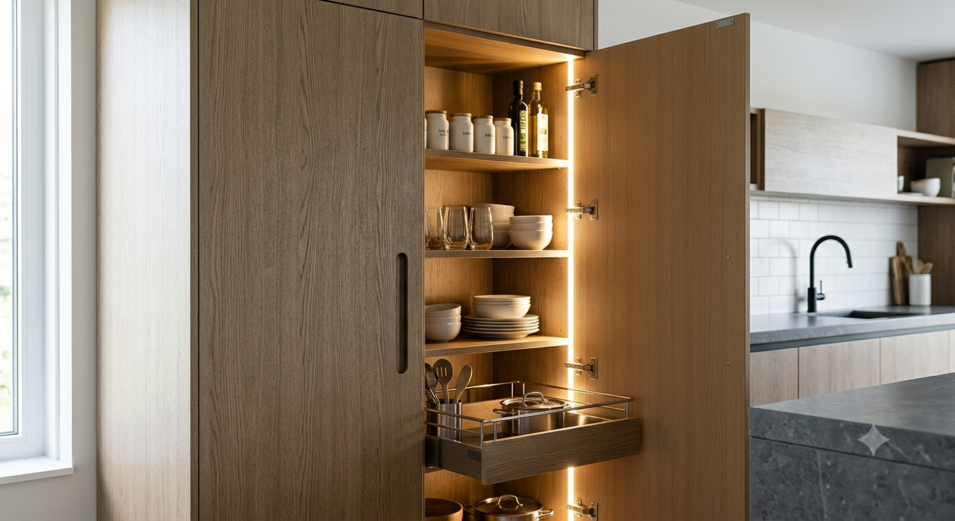
Interior designers optimize every square inch by incorporating tall storage cabinets, drawer organization systems, rotating corner units, and concealed storage solutions.
These strategies help maintain uncluttered countertops while ensuring frequently used items remain easily accessible.
The Role of Lighting in
“Kitchen Cabinet Design”
Lighting is one of the most influential tools in interior design.
Within a “kitchen cabinet design,” LED strip lighting, illuminated shelving, and under-cabinet lighting provide both aesthetic appeal and practical benefits.
Proper lighting improves safety during food preparation while enriching the overall ambiance of the kitchen.
Warm white lighting, in particular, creates an inviting and comfortable atmosphere.
Design Strategies for
Small Kitchens
Interior design solutions are especially important in compact kitchens.
When developing a “kitchen cabinet design” for small spaces, full-height cabinets, light-colored finishes, and reflective surfaces help create the illusion of a larger room.
Minimal decorative details and multifunctional cabinetry allow limited spaces to be used more efficiently.
Hidden storage systems further enhance organization without sacrificing style.
Balanced Design for
Large Kitchens
Although larger kitchens offer greater design flexibility, poor planning may result in an empty or unbalanced appearance.
Therefore, a “kitchen cabinet design” should carefully position kitchen islands, coffee stations, serving areas, and spacious storage units.
Interior designers analyze user movement patterns to create comfortable circulation routes throughout the space.
Sustainable Interior Design and
“Kitchen Cabinet Design”
Sustainability has become an increasingly important aspect of contemporary interior design.
When planning a “kitchen cabinet design,” environmentally friendly materials, low-emission panels, recyclable products, and durable hardware are frequently preferred.
Energy-efficient design solutions not only contribute to environmental sustainability but also reduce long-term operating costs for homeowners.
The Contribution of Smart Technologies to
“Kitchen Cabinet Design”
Technological innovations continue to transform kitchen experiences.
Modern “kitchen cabinet design” increasingly incorporates motion-sensor lighting, electrically operated cabinet doors, automatic drawer systems, and intelligent storage solutions.
Interior designers embrace technology not as a luxury feature but as a functional element that enhances user comfort and convenience.
Conclusion: An Interior Design
Approach to Successful “Kitchen Cabinet Design”
A successful “kitchen cabinet design” is the result of a professional interior design approach that seamlessly combines aesthetics with functionality.
Designs that carefully consider the homeowner’s lifestyle, the physical characteristics of the space, and long-term usability consistently produce the best outcomes.
The right material selection, ergonomic planning, efficient storage solutions, balanced color schemes, premium hardware, and effective lighting all contribute significantly to the overall value of a kitchen.
With an interior design perspective, kitchens become far more than places for cooking—they transform into elegant, comfortable, and highly functional living spaces that enhance everyday life.
Therefore, whether designing a new kitchen or renovating an existing one, approaching the “kitchen cabinet design” process professionally is essential for achieving visual harmony, lasting quality, and long-term user satisfaction.
Aydın Yıldız
Brand Consultant